ගඩොල් බිත්ති බැඳීම (Brick Wall Construction):
Traditional Strength for Modern Sri Lankan Homes
While cement blocks are widely used today, clay bricks (ගඩොල්) remain one of the most preferred, traditional, and durable walling materials in Sri Lankan home construction. Red clay bricks offer exceptional thermal insulation—keeping your indoor spaces cooler under the tropical heat—and provide excellent acoustic isolation.
However, Brick Wall Construction (ගඩොල් බිත්ති බැඳීම) requires meticulous craftsmanship, correct mortar mixing ratios, and proper bonding arrangements to ensure structural integrity.
In this guide, we break down the vital techniques shared by
Why Choose Clay Bricks (ගඩොල්)?
Clay bricks have stood the test of time in Sri Lanka for several compelling reasons:
-
Thermal Comfort: Red clay bricks retain less heat than solid concrete blocks, ensuring your home stays naturally cool.
-
Durability & Longevity: High-quality burnt clay bricks are extremely resilient against moisture degradation.
-
Strong Plaster Adhesion: The rough, porous surface of traditional clay bricks provides a superior mechanical key for cement plastering.
Essential Steps for Brick Wall Construction
Achieving a straight, strong, and long-lasting brick wall requires strict adherence to proper civil engineering standards.
1. Brick Soaking / Pre-Wetting (ගඩොල් පෙඟවීම)
-
Clay bricks are naturally porous and act like sponges when dry.
-
Crucial Practice: Bricks must be thoroughly soaked or sprinkled with water prior to laying. Placing dry bricks on fresh mortar will absorb moisture out of the mix, causing poor hydration, weak cement setting, and eventual wall cracks.
2. Choosing the Right Mortar Ratio (බදාම මිශ්රණය)
-
Standard load-bearing brickwork generally utilizes a 1:5 or 1:6 cement-to-sand ratio.
-
Sand must be properly sieved to remove pebbles or organic particles that disrupt mortar uniformity.
3. Proper Brick Bonding & Staggering (ගඩොල් රටාව සහ සන්ධි)
-
Never align vertical mortar joints from one course directly over the vertical joints of the course below.
-
Bricks must be laid in a staggered pattern (such as Stretcher Bond or English Bond) so that joints are offset. This ensures structural load is distributed evenly across the wall rather than concentrated along a single vertical line.
4. Plumb and Level Checks (ලඹය සහ ලෙවල් බලීම)
-
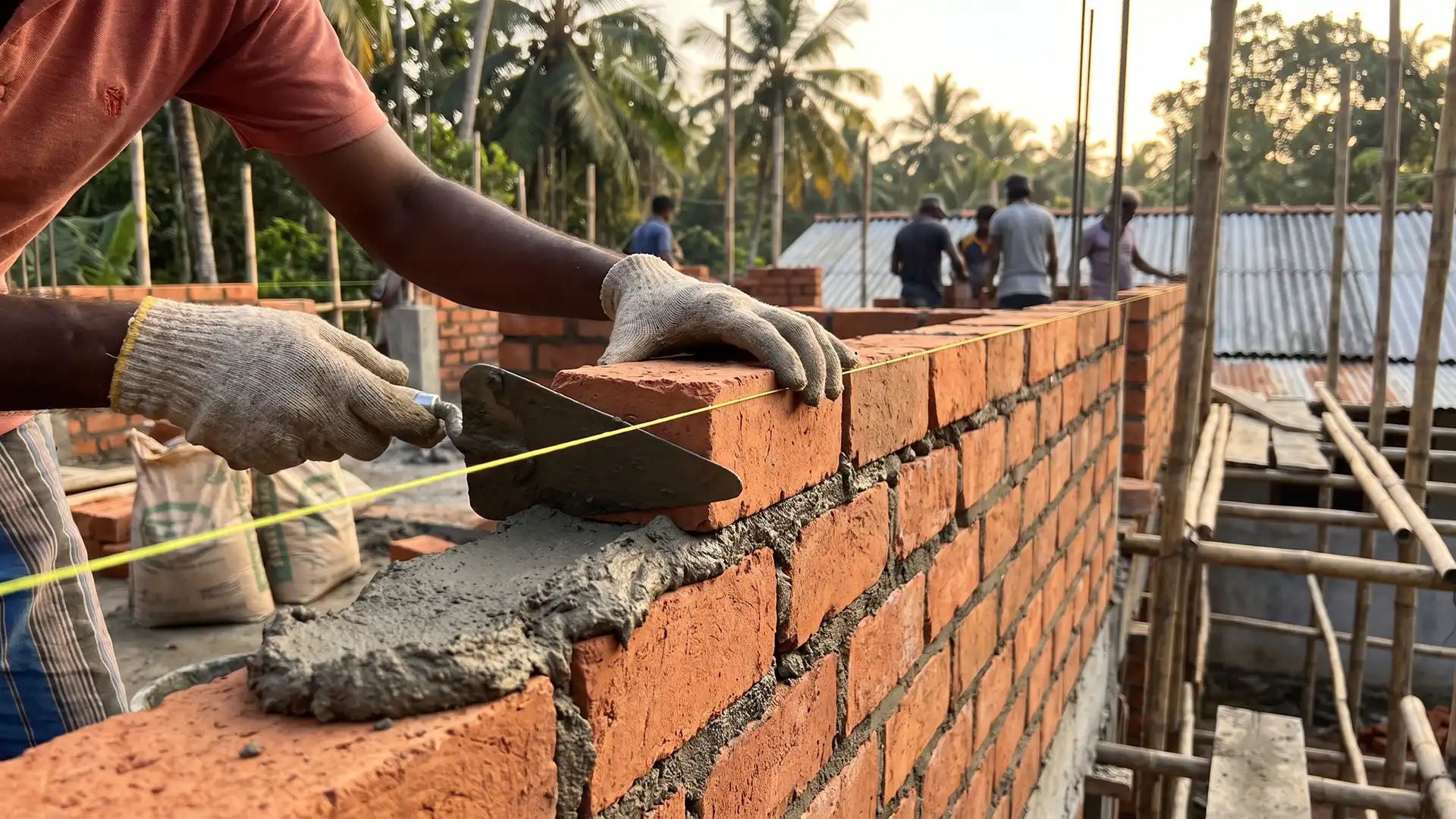
Masonry strings (නූල්) must be stretched tightly along each line of bricks.
-
A plumb bob (ලඹය) and spirit level must be used continuously at every course—especially at corners and door/window openings—to guarantee the wall is 100% vertical.
5. Wall-to-Column Anchorage (ඩවල් බාර් දැමීම)
-
Where brickwork meets RCC concrete columns, dowel bars or wire ties must be embedded into the column joints every few courses to lock the masonry tightly to the structural frame.
Watch the Full Step-by-Step Construction Video
Want to see how red clay bricks are processed, aligned, and laid on a real Sri Lankan construction site? Watch Episode 11 of the Lions Home Lanka House Construction Series on YouTube:
Build Your Dream Home with Lions Home Lanka
Whether you prefer traditional clay brick masonry or contemporary concrete blockwork, Lions Home Lanka ensures uncompromised quality, structural strength, and engineering precision for your dream house.
Contact our expert engineering team today to start your home-building journey!
📞 Contact Us:
-
Office Address: No.576/1, Kadawatha, Sri Lanka.
-
Phone / WhatsApp:
+94 72 7 637 500 -
Email:
info@lionshome.lk -
Official Website:
Lions Home Lanka